
You don’t need a big house or a dedicated classroom to make homeschooling work. What matters most is that your homeschool room or space is an area where kids feel comfortable, organized, empowered, and ready to learn.
As a veteran elementary school teacher, I’ve experienced firsthand that how a learning space is designed can help kids learn academic skills, focus, and also develop important skills like independence, resourcefulness, and confidence.
So, I’ve put together some helpful tips for you as you think about how to set up your homeschool room or area and the goals you want it to accomplish, along with examples of homeschool room designs for ideas and inspiration.
Homeschool Room Design Tips
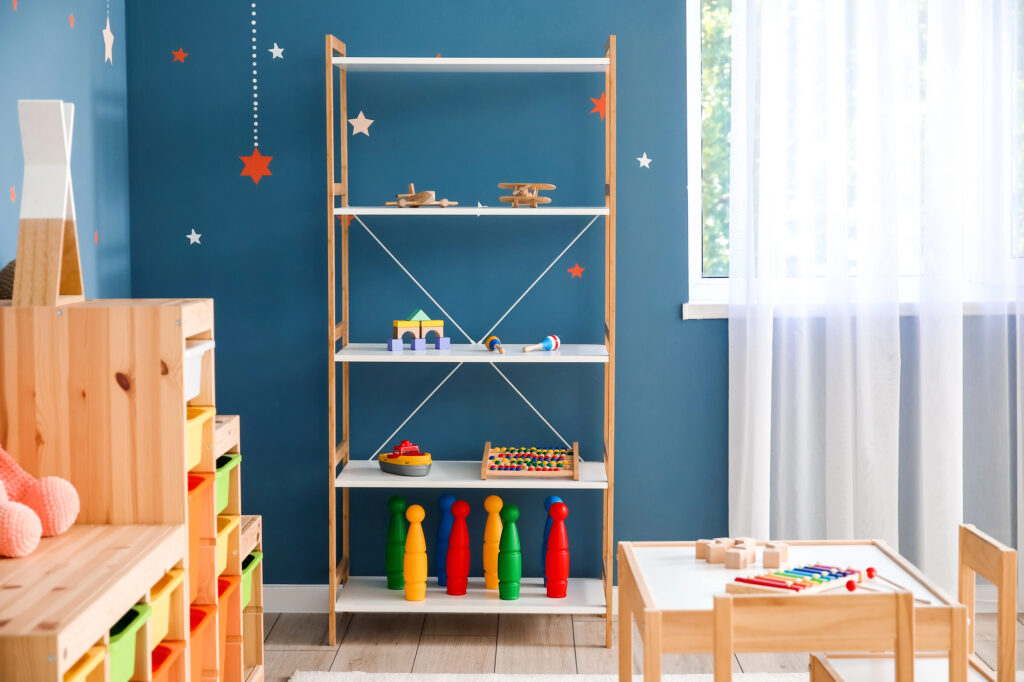
The homeschool room or space you choose is just as important as establishing a daily homeschool schedule. Together, these two ingredients go a long way to setting up you and your family for success.
You don’t need a separate room for homeschooling, but if you have the space, it’ll probably make the most sense rather than using a designated space within an existing room.
You’ll have a better chance keeping (most) materials organized in that space to limit the clutter in other parts of the house. From a learning standpoint, a homeschool room helps kids get into the mindset of school. That doesn’t mean you need a stiff classroom setup. But, it can be easier to build school habits outside of the places in the house where kids already associate them with eating or watching TV.
Ultimately, what matters most is the room or area is set up for its purpose and comfortable for students to work, read, keep their things organized, and reach the learning supplies they need on their own. It should be a kid-centric place by creating a homeschool room design that supports learning and develops independence and a sense of ownership.
Before sharing some homeschool room ideas, here are a few important practical things to keep in mind whether you’re setting up an area somewhere in your living space or using a separate room.
1. Natural light
This is so important for overall mood and energy levels, which play a direct role in how well kids learn and focus.
2. Work Spaces
Collaborative work spaces, like tables, are essential for kids to work together and for you to sit alongside them for instruction or support. Even if you plan to have individual work stations or desks, plan to have a table area for group work.
It’s also a good idea to imagine non-conventional work space ideas. Is there a corner with a cozy chair where someone can sit with a clipboard and work? Do you have a comfortable spot where children, especially younger ones, can work on the floor? Have you created a reading nook with book baskets or shelves where children can easily take books?
A child-centered work space is a friendly place to learn and one that helps kids become more confident, independent, and resourceful learners.
3. Chalkboard or Whiteboard Wall
I love a big wall covered in chalkboard paint so that kids and adults can use the space flexibly.
But even if you can’t use a whole wall, try to set up something more than just a small whiteboard. You’ll likely need more space to teach and show examples. Also, when white boards are hung just for the adult, they are usually out of reach for younger kids which becomes a problem if you want them to show how they solved a problem or work along with you.
4. Wall Space
Always a commodity, especially with younger children. You might need/want to hang visual resources for math and language arts. Do you want an area for kids to hang or show their work? Will you be using pocket charts for spelling words or activities? Are there wall maps that kids need to reference during social studies to complete their work?
Also, will there be something hanging like a cork board, peg board, or magnet board that’s meant to be interactive or used by the kids? Make sure it’s on the lower part of the wall so they can use it independently.
5. Organize, Organize, Organize!
From the earliest school ages, empower your kids to organize, use, and put away their personal materials and the homeschool supplies. They’ll feel confident in the predictability and you’ll eliminate a lot of their questions about where things are. Also, the less you micro-manage, the more you’re free to work with another child or get materials ready for another part of the day.
This means using things like folder boxes (magazine files), bins, baskets, and containers that are clearly labeled for specific materials. Arrange these supplies at work stations, on rolling carts, or on shelves that are not only the right size for your children but clearly say that it’s ok to grab things from here.
6. Be Mindful of Distractions
Watch the positioning of screens whether it’s a computer or television, especially if one child is doing something on a screen when another one is not. If your homeschool is in a common space in the house, put away toys or other tempting items that could steal focus.
Homeschool Room Ideas & Inspiration (From my Teacher’s Eye)
With these tips in mind, let’s look at some homeschool room ideas together. I’ve shared some of my thoughts as a teacher about what jumped out to me as important in these spaces.
Collaborative Work Tables & Flexible Learning Zones
I’m a big believer in work tables over individual desks. If you’re not sure which is best for your children, test out a hybrid solution. A surface top can be set up for each student to have his/her own workspace but let them move their chairs together to work on a group project or play a partner game. If you’re leaning towards individual desks, think about having a table somewhere for collaborative work or even when you want to sit with your child for support or an activity.
It’s also ideal to have a variety of places for kids to work/sit during the day. Younger kids, especially, will wiggle out of their chairs after just one read-aloud! So having comfortable places for floor work with clipboards or specific learning stations or areas for different activities lets them move their bodies, be in more relaxed positions, and helps them refocus.
Here are a few examples I really like.
I love how this homeschool room combines the best of all worlds. There are individual work stations for three children. The two chairs on the end can easily turn towards the middle work area for collaborative work.
The sofa has a basket of books next to it for a comfortable space to read. Plus, the floor is carpeted which makes it easy to imagine kids using the floor space, too.
This homeschool room is clearly for older students but the relaxed vibe makes it such an inviting place to learn. I absolutely love the different seating options. The computer workstations are in the back, with the white table and green stools as another place for work to happen.
And don’t you just love the swings? I can just imagine a student sitting on one to think, move, or read. Plus, the sofa with the book basket on the coffee table makes it almost feel like a coffee house where you’d go to comfortably read and study.
I love the collaborative tables in this homeschool design. But, what caught my eye was how many different seat types are in this one small space! The backed chairs for older and younger kids are what you might expect. There’s also a gray stool that lets the child sitting in it rock and sway. The little stools are great for little ones who want to straddle their legs.
The sofa in this homeschool room is even more important than in the other examples for a soft place to sit because of the hardwood floor. If you don’t have the space for a sofa in your homeschool space, be creative with floor pillows, beanbag chairs, or even roll up throw rugs. For one of my classrooms, I bought small throw rugs from Ikea and they were always the first to be grabbed during independent reading time.
Minimalist & Focus-Friendly Workspaces
Even as a teacher of young elementary students, I was never a fan of the bright primary color palette that seemed to be the default for classroom decor. So I appreciate homeschool room designs with a softer set of colors.
And while I wouldn’t describe my classrooms as minimalist (it’s just a lot harder to do in a classroom with 18-20 children), I always tried to create a few places with less visual distractions to help kids working in them focus and reduce their overall sensory intake.
In this homeschool space, the wall hangings with the letters, numbers, and days of the week are in such a soft, yet kid-friendly, color palette. And overall, the space is free from all distractions. Even the organizer in the middle has doors to keep anything that could steal focus stored away. The lack of clutter has such a calming effect!
The long work surface also supports both individual and group work. It also is a thoughtful option if you don’t have a designated homeschool room and want the design to match the overall tone of your home.
This homeschool room is similarly designed as the one above. On top of that, I love the clipboards hanging at each work station. It could be a perfect way to keep track of individual student plans and learning playlists that support student independence.
I also love the rounded table for partner work and collaborative learning. It’s a great use of the space and gets kids moving during the day.
Walls to Promote Learning
Think about the wall space you have in your homeschool room or area. Visual learning supports are so important, especially during the elementary years. Sure, they remind a child how to spell a particular word, but they also teach the strategy of looking around the environment for resources that can help solve a problem. I’ve seen how empowering this is for kids, especially the ones who struggle with reading or are building confidence in themselves as learners.
And as you make decisions about chalkboards and whiteboards, think not only of using it for yourself to demonstrate skills. These wall spaces can also be used by kids to write, problem-solve, and work together with you or other kids on a task.
I love the concept word charts on the wall, but I especially love that there’s a 100s Chart. My students loved getting up to use it to skip count or help them with their math work. Plus, it’s a great visual assessment for you to see how they’re using it for math and their overall confidence to find the tools they need to problem-solve. Hanging an analog clock is a great way to passively teach this important skill over time.
The pegboard with the supplies on the wall is also a great use of the space for organization and letting the kids be independent in using and putting away the materials they need. And the iPad stands are perfect for younger and middle elementary students who don’t yet use a keyboard and computer for assignments so don’t need a permanent computer station.
Here, the full wall space to write or draw is an excellent idea. Both kids and adults can reach and use the space. Plus, for instruction purposes, you’ll be able to write in large letters and numbers with plenty of space to easily show everything you need.
Also, the natural light in this homeschool room is amazing!
It’s so important for kids to see and have access to large wall maps as they get to the middle elementary years and beyond to continually understand the world around them! Geography is such a frustratingly undertaught skill in so many schools.
I also love that the instructional wall space, while not huge, effectively combines a higher level for the display of things the adult wants to be visual and a lower section with a white board and chalkboard that both adults and kids can use. Between those areas, there looks to be a number line and in the corner a pocket chart for words of the week, possibly.
One last thing that caught my eye were the pencil/supply caddies on top of the shelf. While it might seem like an insignificant detail, these caddies are portable and can be set up with the supplies kids need whether they’re heading to a desk, table, or onto the floor with a clipboard.
Areas for Specific Activities
If you have the space or can even be creative with corners, create zones that trigger the mindset you want for a specific activity in the same way a distraction-free space is meant to help with focus and sensory overload.
Here are a few ideas to think about for your homeschool room.
A cozy reading nook is the most classic example of a space like this! And this one is the perfect mix of pillows, a soft rug, a chair, and book display shelves to spark interest or draw attention to specific titles. Plus, the small details like the string of lights and plant in the corner complete the look that says this space is for quiet, relaxing reading.
One look and it’s clear that this space is for reading. The comfy chair would be something to look forward to with your favorite book. Add to that the lamp, rug, and L-shaped bookshelves with a range of things to read and the space is ready for readers of all ages.
The chalkboard in the library is a great touch if you can spare it for kids’ book recommendations, reading challenges, or reminders about important reading habits.
The zones in your homeschool area don’t have to be all about reading, though!
I love how these tables are being used for math activities and can easily imagine how useful an area of grouped desks or tables could be to set up for all types of activities from word games to science experiments. You’d be able to prepare it ahead of time or while students work on other independent tasks without disturbing them.
It would be a luxury to have so much space for your homeschool preschool room!
But if you’re setting up your homeschool for Pre-K or Kindergarten, think about defined areas for imaginative play, block play, and/or a carpeted area for read alouds and book exploration.
If you’re using themed, unit studies in your homeschool (and I recommend you do!), imagine how at least one shelf or area could be used to bring together materials and activities for that topic of study.
For younger students, the shelves in the example are set up for child-centered learning and exploration. But even for older students, you could include books, scavenger hunt-style games to direct research, artifacts, music, relevant materials for experiments, and a mix of primary and secondary sources like art or models.
Organization that Builds Independence
Labeled bins, kid-height shelves, and predictable routines and systems around folders, student work and supplies starts with the homeschool room design you decide.
Kids of all ages can start managing materials in an age-appropriate way. So before you choose only tall vertical shelves or organize everyday homeschool supplies in non-descript containers, think about what you can do to help your kiddos be as independent as possible.
These organization routines will not only save your sanity on the day-to-day of teaching but they also build student’s confidence and model important organization habits.
I love how this homeschool space combines so many helpful elements without being too minimalist or too cluttered. The materials are organized in a way that shows there’s a system but still lets each child add a bit of their own personal style on the pegboards and at their workstations.
The folder boxes/magazine files are so helpful in a classroom of any kind! Subject folders and notebooks can be neatly kept in them and kids can easily grab the work they need when it’s time without searching high and low for it. I can’t explain how valuable a system like this is when it’s implemented at a young age and repeated year after year!
What caught my eye in this example were the paper baskets on top of the shelf. These could simply be for different types of paper or they could be places where your kids know to look for assignments and turn in work independently…especially while you’re potentially working with another child.
The supplies on the table are also organized into cups and within reach for all to use. It’s clear where to get them (no need to ask) and where to put them away (predictable expectation when you say it’s time to clean up).
In my classroom, there was a basket for homework folders. Each child knew where to put it every morning without having to ask. They had color-coded folders for different subjects and if they forgot, there was a color key on the wall so they could double-check. Pencils, scissors, different types of paper, art supplies, dice and cards for math games…they all had a place in easy-to-reach places to help kids understand what to expect, where to find things, and help them feel successful in the flow of the classroom as they went about their work.
Here is a great example of what I am talking about. The shelves are kid-height and labeled with names and pictures. Whether they’re readers or not, everyone knows where to find and put materials.
Also as a sidenote, this is one of the only homeschool room photo examples I found with clipboards. I’m sure they’re being used in many homes. But if you haven’t thought about them yet, consider this a friendly piece of advice that they are so useful while at home and out on field or research trips.
Bottom Line
Everyone’s homeschool room will look a little different, and that’s a good thing. What matters is that the choices you’re making about the design are intentional and create a learning space that helps your kids feel capable, confident, and excited to learn. 😉
Like this post? Please save it on Pinterest or share it on social media using the share buttons.
Leave a Reply